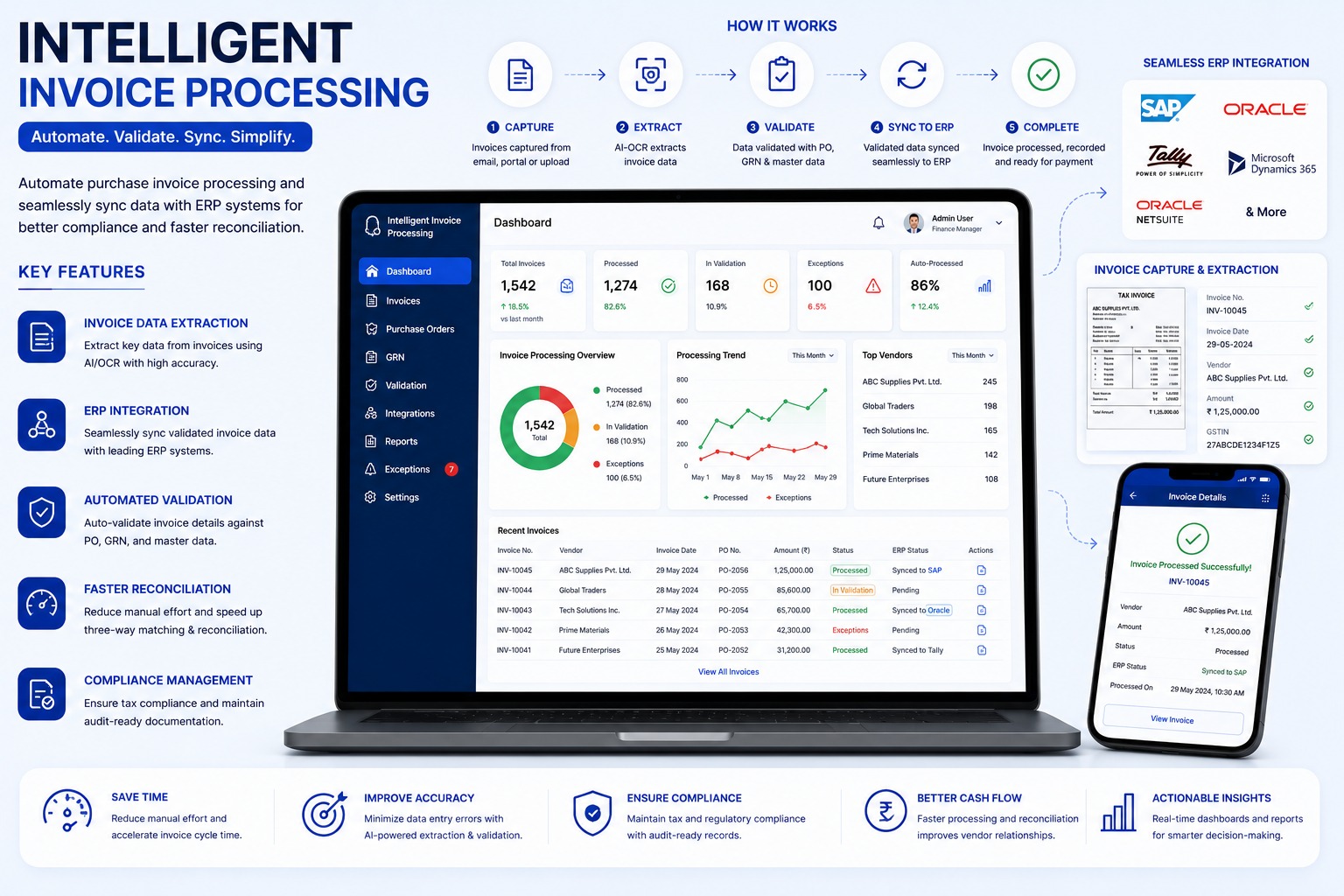
Accounts payable teams often receive invoices in different formats from email, portals, scans, and manual uploads. Intelligent invoice processing uses AI-OCR and validation rules to reduce manual entry and posting delays.
From Capture To ERP
The system captures invoices, extracts vendor, invoice, PO, tax, line-item, and amount details, validates them against business records, routes exceptions, and posts approved data to the ERP.
PO, GRN And Duplicate Checks
Three-way matching compares invoice details with purchase orders and goods receipt notes. Duplicate checks reduce the risk of repeated processing and payment.
Typical Exception Reasons
- Duplicate invoice
- PO or GRN mismatch
- Missing vendor master data
- Invalid tax details
- Amount or quantity difference outside tolerance
Better Cash Flow Visibility
Dashboards can show invoices processed, pending approval, under validation, failed in ERP sync, or waiting for correction. This helps finance teams plan payments and improve vendor relationships.
Explore the Intelligent Invoice Processing
Automate invoice data extraction using AI-OCR, perform 3-way PO-GRN matching, exception handling, and direct ERP posting.
Intelligent Invoice Processing FAQs: Features, Workflows & Best Practices
Comprehensive answers to frequently asked technical, operational, and implementation questions about intelligent invoice processing in India.
What is Intelligent Invoice Processing and how does AI-OCR revolutionize Accounts Payable (AP)?
Intelligent Invoice Processing is an automated AP solution combining Artificial Intelligence, Machine Learning, Optical Character Recognition (AI-OCR), and business rule validation to ingest invoices from emails or scans, extract header and line-item details, match them against POs, and post records directly to ERPs.
Can the AI-OCR engine extract data accurately from diverse vendor invoice layouts, PDFs, and scanned photos?
Yes. Unlike rigid legacy template OCRs that break when invoice formatting changes, our AI-OCR uses cognitive layout models to recognize invoice numbers, dates, GSTINs, PO numbers, line-item descriptions, quantities, rates, and tax subtotals across varied supplier formats.
How does the system conduct automated 3-way matching between Invoices, Purchase Orders (PO), and Goods Receipts (GRN)?
The system connects with your ERP to compare extracted invoice line items against corresponding Purchase Order (PO) quantities/rates and Goods Receipt Note (GRN) accepted quantities. If line items match within configured tolerance limits, it clears the invoice for automated payment approval.
What happens when an invoice has missing fields, math discrepancies, or low-resolution text?
When an anomaly or confidence score threshold is triggered (e.g., total tax doesn't sum up, or unreadable scan), the invoice is routed to an intuitive human-in-the-loop review dashboard where an AP executive can review the highlighted discrepancy side-by-side with one click.
How does the system prevent duplicate invoice processing and accidental vendor overpayments?
The platform executes multi-parameter duplicate checks—verifying vendor GSTIN, invoice number, invoice date, and total amount against both pending queue records and historical ERP archives, instantly flagging duplicate submissions.
Can validated invoice data be posted directly into SAP, Tally, Oracle, or custom ERP systems?
Yes. Approved invoices are posted straight into your accounting or ERP platform (such as SAP MIRO/FB60, Tally Purchase Voucher, Oracle AP, or Dynamics) via REST APIs, database connectors, or automated bot scripts, eliminating manual rekeying.
Does the system calculate and extract TDS deductions, TCS, and statutory GST tax breakdowns?
Yes. The system parses CGST, SGST, IGST, RCM liabilities, and applicable TDS deductions (under Sections 194C, 194J, 194Q) to ensure compliant accounting entries aligned with Indian statutory taxation norms.
How much does intelligent invoice processing compress the invoice approval and settlement cycle?
Traditional manual invoice cycles taking 5 to 12 days for manual typing, physical routing, and manager sign-offs are compressed into a 2 to 4 hour automated pipeline, enabling companies to capture early-payment cash discounts from vendors.
What security standards and encryption safeguard confidential corporate invoices and vendor banking data?
All invoices and extracted financial data are secured using end-to-end TLS 1.3 in transit and AES-256 encryption at rest, backed by strict role-based access controls and detailed document audit logs.
What percentage reduction in accounts payable operational processing cost can organizations achieve?
Enterprise finance departments typically achieve a 70% to 85% reduction in invoice processing costs and over 99% data extraction accuracy, allowing AP personnel to shift focus from manual data entry to strategic vendor relations.
Have more questions about implementing Intelligent Invoice Processing for your organization?
Explore Official Intelligent Invoice Processing Page -> Speak With Our Solution Experts