
Intelligent Invoice Processing
Capture invoices, extract data using AI-OCR, validate against PO/GRN/GST, and sync approved records to ERP.
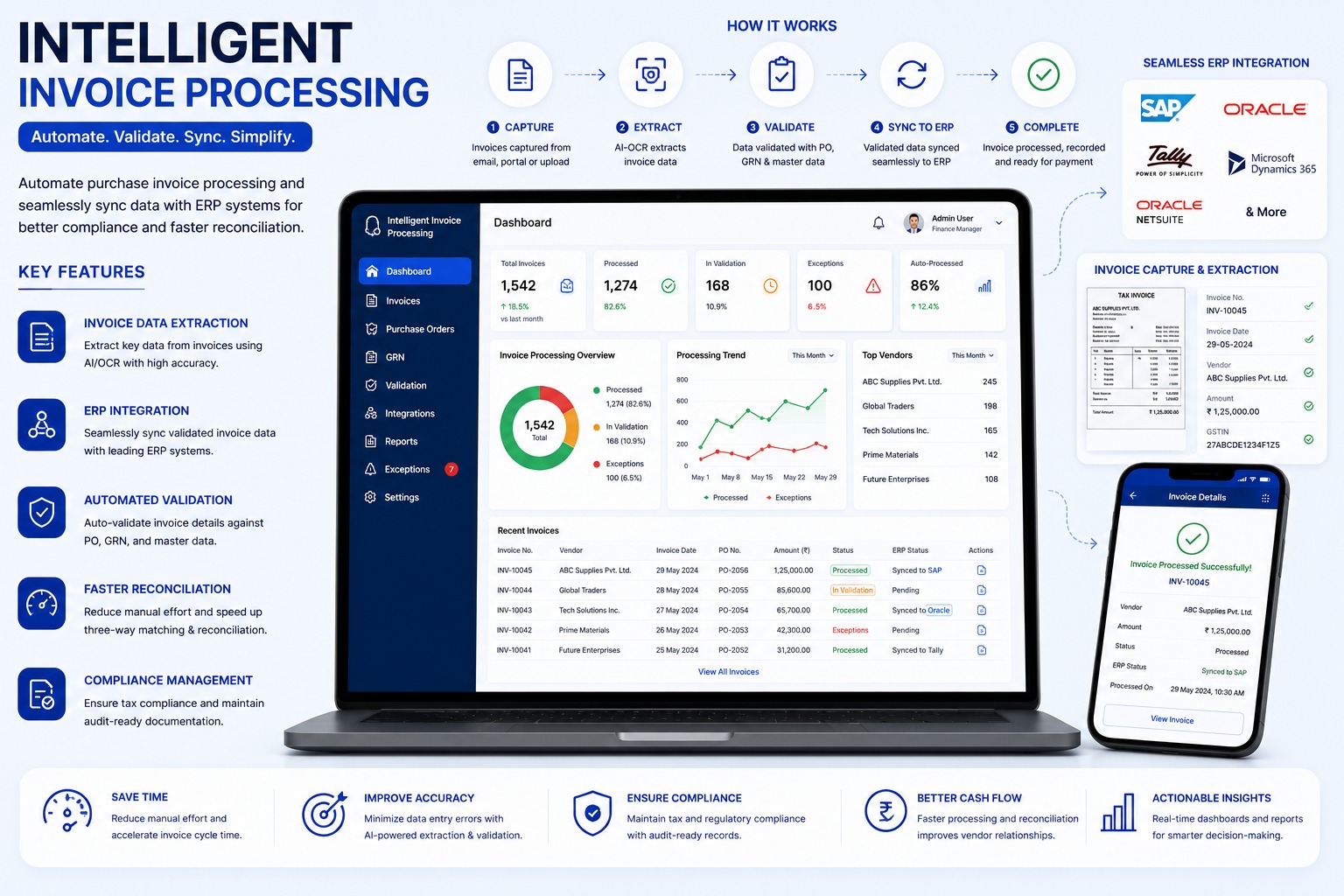
Core Robot Capabilities
Eliminates mundane keystrokes, data validation mismatches, and delayed exports.
Invoice capture from email, PDFs, scans, and portals
Executes via scheduled background daemon or trigger-based queues with exception handling and email alerts.
AI-OCR extraction
Executes via scheduled background daemon or trigger-based queues with exception handling and email alerts.
PO, GRN, GST, and vendor validation
Executes via scheduled background daemon or trigger-based queues with exception handling and email alerts.
ERP integration
Executes via scheduled background daemon or trigger-based queues with exception handling and email alerts.
Exception handling
Executes via scheduled background daemon or trigger-based queues with exception handling and email alerts.
Finance dashboard
Executes via scheduled background daemon or trigger-based queues with exception handling and email alerts.
Systems, ERPs & Portals Connected
This automation bot connects seamlessly with the following target software environments:
Technical & Implementation Q&A (20 Answers)
Learn how this bot operates without breaking security, how errors are routed, and timeline for production deployment.
What is Intelligent Invoice Processing and how does AI-OCR revolutionize Accounts Payable (AP)?▾
Intelligent Invoice Processing is an automated AP solution combining Artificial Intelligence, Machine Learning, Optical Character Recognition (AI-OCR), and business rule validation to ingest invoices from emails or scans, extract header and line-item details, match them against POs, and post records directly to ERPs.
Can the AI-OCR engine extract data accurately from diverse vendor invoice layouts, PDFs, and scanned photos?▾
Yes. Unlike rigid legacy template OCRs that break when invoice formatting changes, our AI-OCR uses cognitive layout models to recognize invoice numbers, dates, GSTINs, PO numbers, line-item descriptions, quantities, rates, and tax subtotals across varied supplier formats.
How does the system conduct automated 3-way matching between Invoices, Purchase Orders (PO), and Goods Receipts (GRN)?▾
The system connects with your ERP to compare extracted invoice line items against corresponding Purchase Order (PO) quantities/rates and Goods Receipt Note (GRN) accepted quantities. If line items match within configured tolerance limits, it clears the invoice for automated payment approval.
What happens when an invoice has missing fields, math discrepancies, or low-resolution text?▾
When an anomaly or confidence score threshold is triggered (e.g., total tax doesn't sum up, or unreadable scan), the invoice is routed to an intuitive human-in-the-loop review dashboard where an AP executive can review the highlighted discrepancy side-by-side with one click.
How does the system prevent duplicate invoice processing and accidental vendor overpayments?▾
The platform executes multi-parameter duplicate checks—verifying vendor GSTIN, invoice number, invoice date, and total amount against both pending queue records and historical ERP archives, instantly flagging duplicate submissions.
Can validated invoice data be posted directly into SAP, Tally, Oracle, or custom ERP systems?▾
Yes. Approved invoices are posted straight into your accounting or ERP platform (such as SAP MIRO/FB60, Tally Purchase Voucher, Oracle AP, or Dynamics) via REST APIs, database connectors, or automated bot scripts, eliminating manual rekeying.
Does the system calculate and extract TDS deductions, TCS, and statutory GST tax breakdowns?▾
Yes. The system parses CGST, SGST, IGST, RCM liabilities, and applicable TDS deductions (under Sections 194C, 194J, 194Q) to ensure compliant accounting entries aligned with Indian statutory taxation norms.
How much does intelligent invoice processing compress the invoice approval and settlement cycle?▾
Traditional manual invoice cycles taking 5 to 12 days for manual typing, physical routing, and manager sign-offs are compressed into a 2 to 4 hour automated pipeline, enabling companies to capture early-payment cash discounts from vendors.
What security standards and encryption safeguard confidential corporate invoices and vendor banking data?▾
All invoices and extracted financial data are secured using end-to-end TLS 1.3 in transit and AES-256 encryption at rest, backed by strict role-based access controls and detailed document audit logs.
What percentage reduction in accounts payable operational processing cost can organizations achieve?▾
Enterprise finance departments typically achieve a 70% to 85% reduction in invoice processing costs and over 99% data extraction accuracy, allowing AP personnel to shift focus from manual data entry to strategic vendor relations.
Can the system remind approvers about pending invoices?▾
Yes. It can send reminders and escalation alerts for pending or overdue approvals so invoices do not remain stuck unnecessarily.
Can validated invoices be posted directly into SAP, Oracle, Tally, or another ERP?▾
Yes. Approved invoice data can be synchronized with supported ERP systems such as SAP, Oracle, Tally, Microsoft Dynamics 365, Oracle NetSuite, and other systems through available integrations.
What happens if the ERP connection fails while posting an invoice?▾
The invoice can be marked as pending or failed, and the system can retry the synchronization. The error message and ERP response are recorded for troubleshooting.
Can users see which invoices are processed, pending, failed, or under validation?▾
Yes. The dashboard can display total invoices, processed invoices, invoices under validation, exceptions, approval status, and ERP synchronization status.
Can we see exactly why an invoice was rejected or moved to the exception queue?▾
Yes. Each exception can include the reason, such as duplicate invoice, PO mismatch, missing GRN, invalid tax details, incorrect vendor, missing field, or amount difference.
Can the system maintain the original invoice and all related processing records?▾
Yes. The original invoice, extracted data, validation results, approval history, ERP reference, user actions, and timestamps can be stored together for future reference.
How does the system help with tax and regulatory compliance?▾
It can validate tax numbers, tax rates, invoice dates, mandatory fields, vendor details, and other configured compliance rules. It also maintains audit-ready records of the complete invoice process.
Can auditors track who reviewed, changed, approved, or posted an invoice?▾
Yes. The audit trail can show every action, including who uploaded, edited, validated, approved, rejected, or synchronized the invoice and when the action occurred.
Can management identify processing delays and vendor-related issues?▾
Yes. Reports can show invoice processing time, pending approvals, exception rates, vendor-wise invoice volume, mismatch reasons, ERP failures, and processing trends.
How does intelligent invoice processing improve cash flow and vendor relationships?▾
It speeds up invoice capture, validation, approval, and ERP posting, which helps payments move on time. Faster processing, fewer disputes, better exception visibility, and accurate payment status improve cash-flow planning and vendor trust.
Read the Complete Bot Engineering Story
Learn how this automation was conceived, the edge cases handled, and the audited efficiency gains.
Connect With Our Engineering Desk
Speak directly with our automation consultants about robotic process automation, ERP rollout feasibility, or custom Flutter platforms.
Direct Call & WhatsApp
+91 87226 29900Cloud & Google Desk
+91 83905 00190Direct Official Email
customerdelight@bhar.co.inBlue Horizon Automation Research Pvt. Ltd. (BHAR India)
Office No. 26/27, 3rd Floor, Matru Chhaya Apartment,
Opp. Kapeesh Mall, MG Road, Mulund West,
Mumbai, Maharashtra – 400080
Send a Direct Enquiry
Inquiries are logged directly into Firestore and delivered to our senior engineering desk.