
E-KYC Government Portal Automation
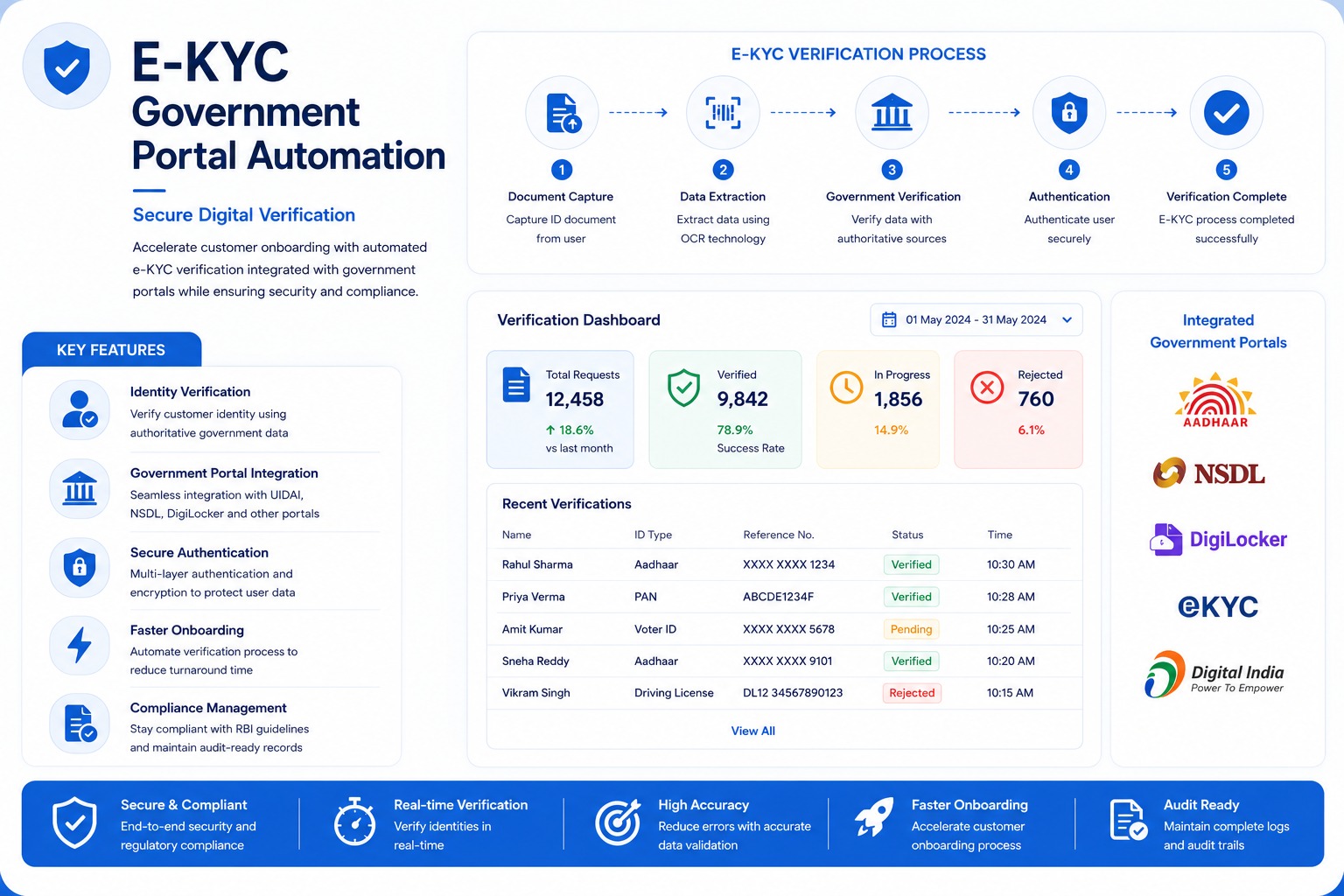
Automate onboarding, identity verification, document validation, consent authentication, and audit-ready KYC workflows.
Core Robot Capabilities
Eliminates mundane keystrokes, data validation mismatches, and delayed exports.
Aadhaar, PAN, voter ID, and document checks
Executes via scheduled background daemon or trigger-based queues with exception handling and email alerts.
Government portal integration
Executes via scheduled background daemon or trigger-based queues with exception handling and email alerts.
Consent-based authentication
Executes via scheduled background daemon or trigger-based queues with exception handling and email alerts.
Automated validation
Executes via scheduled background daemon or trigger-based queues with exception handling and email alerts.
Audit logs and reports
Executes via scheduled background daemon or trigger-based queues with exception handling and email alerts.
Fraud risk reduction
Executes via scheduled background daemon or trigger-based queues with exception handling and email alerts.
Systems, ERPs & Portals Connected
This automation bot connects seamlessly with the following target software environments:
Technical & Implementation Q&A (20 Answers)
Learn how this bot operates without breaking security, how errors are routed, and timeline for production deployment.
What is E-KYC Government Portal Automation and how does it transform customer onboarding?▾
E-KYC Government Portal Automation is an identity verification workflow that automates the collection, document OCR extraction, validation against authorized government databases (such as UIDAI, NSDL/Income Tax, DigiLocker, and Vahan), and compliance archiving for rapid customer onboarding.
Which government identity documents (Aadhaar, PAN, Passport, Driving License, Voter ID) can be verified?▾
The system verifies all standard Indian KYC documents—including Aadhaar cards (with masked UID compliance), PAN cards, Passports, Driving Licenses, Voter ID cards (EPIC), and commercial documents like GSTIN registration certificates.
How does AI-powered OCR extract data from uploaded identity card photos and scanned documents?▾
AI computer vision models automatically detect document types, crop borders, rotate skewed images, and extract cardholder name, father's name, date of birth (DOB), document number, and residential address with high precision even from mobile camera snapshots.
How does the system verify extracted details against authorized government and regulatory registries?▾
The automation queries authorized verification APIs in real time to validate PAN status with the Income Tax/NSDL database, verify Aadhaar OTP authentication via UIDAI protocols, and validate driving licenses through the Parivahan portal.
What exception workflows handle blurred, cropped, low-resolution, or suspicious identity uploads?▾
The system features real-time image quality evaluation checks that detect blurred images, screen glares, or cropped corners during customer upload, immediately prompting the applicant to re-upload a clear copy before submission.
How does the E-KYC workflow enforce compliance with statutory RBI, UIDAI, and DPDP privacy regulations?▾
The system enforces Aadhaar number masking (displaying only the last 4 digits), collects explicit user consent with timestamped audit trails, stores encrypted verification tokens, and strictly complies with the Digital Personal Data Protection (DPDP) Act.
Does the solution support facial liveness detection and selfie-to-ID photo matching?▾
Yes. The platform integrates passive or active 3D liveness detection to prevent spoofing using photographs or video recordings, running biometric facial comparison between the live customer selfie and the photo on the official ID card.
How much does digital E-KYC automation compress customer onboarding turnaround times?▾
Manual physical paper KYC taking 3 to 7 days for courier collection, manual verification, and data entry is reduced to an automated digital verification process completed in under 2 minutes.
Can the E-KYC verification engine integrate into existing mobile apps, websites, and CRM systems via APIs?▾
Yes. The solution provides modern RESTful APIs and lightweight SDKs for mobile apps (Flutter, Android, iOS) and web applications, enabling seamless integration into onboarding funnels and CRM workflows.
What audit trails, verification logs, and compliance dossiers are generated for regulatory inspection?▾
For every completed verification, the system compiles a tamper-evident digital KYC verification dossier containing timestamped verification responses, API reference IDs, matched score ratios, and IP logs ready for regulatory inspection.
How does the system securely authenticate the customer?▾
It can support authentication methods such as OTP, registered mobile verification, secure login, consent confirmation, document-based verification, or other approved methods depending on the integration.
Is customer identity data secure in the system?▾
The system can use encrypted communication, secure storage, role-based access, masked document numbers, authentication controls, and activity logs. The final security configuration depends on the deployment environment and compliance requirements.
Can we control which employees can view sensitive KYC documents?▾
Yes. Permissions can be configured so that only authorized users can view, download, approve, reject, or update KYC records. Sensitive information can also be masked for users who only need limited access.
Can the system integrate with Aadhaar, NSDL, DigiLocker, and other government portals?▾
Integration may be possible through authorized APIs, approved service providers, or officially supported verification channels. Actual access depends on eligibility, consent requirements, regulatory approvals, and the availability of each portal’s integration service.
What happens if a government portal or verification service is temporarily unavailable?▾
The request can remain pending and be retried automatically or manually once the service becomes available. The customer does not need to restart the entire onboarding process.
Can users see why a KYC request was rejected?▾
Yes. The system can show the rejection or exception reason, such as invalid document number, expired document, incorrect OTP, data mismatch, poor image quality, unsupported document, or unavailable verification service.
Can rejected KYC requests be corrected and submitted again?▾
Yes. Authorized users or customers can correct the relevant details, upload a new document, or repeat authentication. The revised request can then be submitted again while preserving the previous verification history.
Can management monitor all verification requests from one dashboard?▾
Yes. The dashboard can display total requests, verified cases, pending requests, rejected applications, success rates, processing time, and recent verification activities.
Does the system maintain records for audits and regulatory reviews?▾
Yes. It can maintain uploaded documents, consent details, extracted data, verification responses, approval history, user actions, timestamps, rejection reasons, and final status for audit purposes.
How does E-KYC automation improve the overall customer onboarding process?▾
It reduces paperwork, manual verification effort, data-entry mistakes, duplicate applications, and processing delays. It also improves accuracy, customer experience, compliance tracking, real-time visibility, and audit readiness.
Read the Complete Bot Engineering Story
Learn how this automation was conceived, the edge cases handled, and the audited efficiency gains.
Connect With Our Engineering Desk
Speak directly with our automation consultants about robotic process automation, ERP rollout feasibility, or custom Flutter platforms.
Direct Call & WhatsApp
+91 87226 29900Cloud & Google Desk
+91 83905 00190Direct Official Email
customerdelight@bhar.co.inBlue Horizon Automation Research Pvt. Ltd. (BHAR India)
Office No. 26/27, 3rd Floor, Matru Chhaya Apartment,
Opp. Kapeesh Mall, MG Road, Mulund West,
Mumbai, Maharashtra – 400080
Send a Direct Enquiry
Inquiries are logged directly into Firestore and delivered to our senior engineering desk.